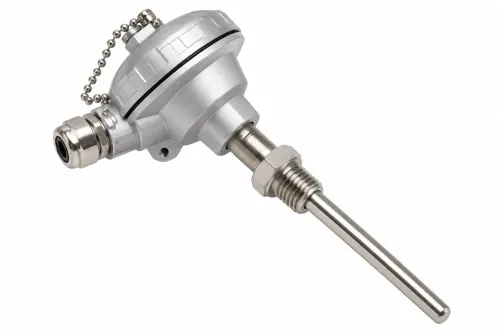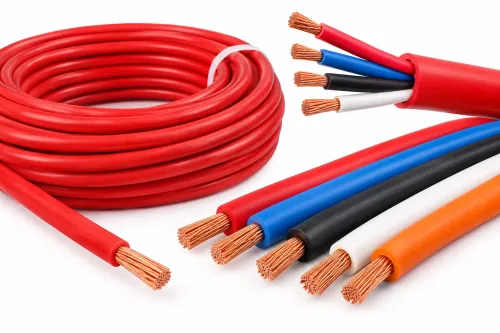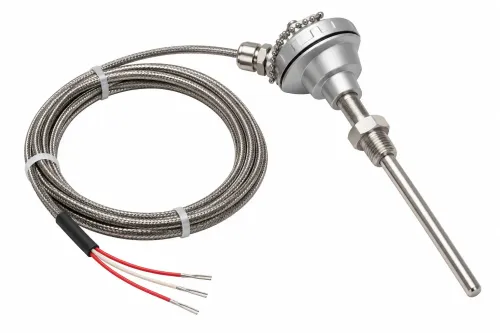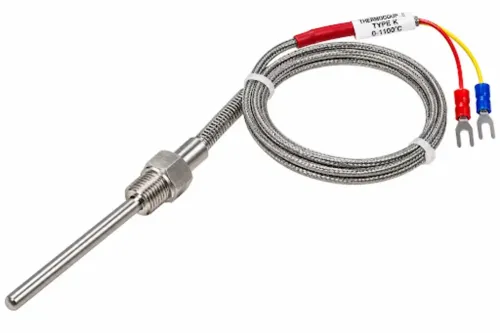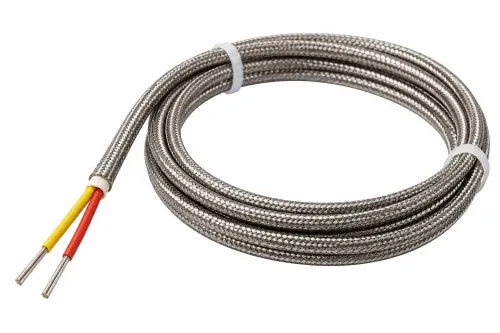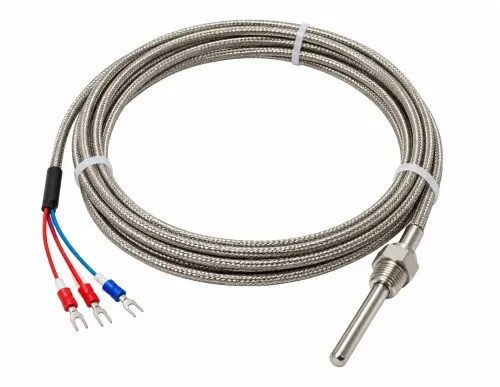
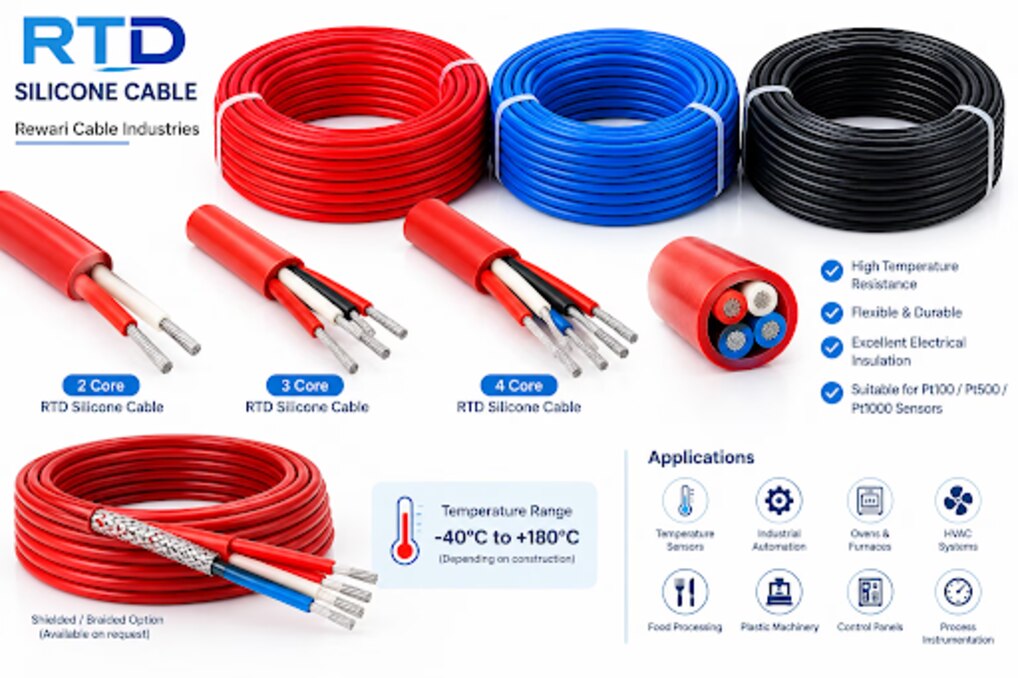
A catalogue label such as “Pt100 cable” does not reveal whether a cable will deliver accurate readings through a long, hot, noisy, wet, or moving installation. You will be able to compare manufacturers against the measurement circuit, complete cable construction, operating environment, test evidence, and total ownership effort before approving a supplier.
Key takeaways
- Define Pt100 wiring, accuracy class, length, and transmitter input first.
- Match insulation, shielding, conductor size, and temperature rating to the installation.
- Request samples, test reports, calibration evidence, and traceable material details.
- Compare lifecycle cost, replacement risk, lead times, and engineering support.
Define the RTD circuit before comparing manufacturers
Choose the conductor count from the transmitter input, required accuracy, cable length, and installation temperature—not from the sensor name alone. IEC 60751 defines the platinum RTD reference characteristics; for a common Pt100, Class A tolerance is ±(0.15 + 0.002|t|) °C and Class B is ±(0.30 + 0.005|t|) °C.
A quoted cable temperature rating does not prove measurement accuracy.
- Confirm the sensor type and instrument input: Pt100, Pt500, or Pt1000; IEC 60751 or another specified standard; Class A or Class B; and the transmitter’s supported wiring method.
- Select two wires only when lead resistance is acceptable or the instrument provides compensation. A Pt100 changes about 0.385 Ω/°C near 0 °C, so 1 Ω of total lead resistance creates roughly 2.6 °C of error.
- Select three wires when the instrument supports three-wire compensation. Require two sensing leads with substantially equal resistance, equal length, and similar temperature exposure; compensation does not correct unequal conductors or connector resistance.
- Select four wires when the error budget is tight, the route is long, or temperature gradients are severe. The instrument measures through separate current and voltage pairs, removing lead resistance more completely.
| Option | Practical specification | Selection check |
|---|---|---|
| Pt100 cable | Low lead resistance is critical | State resistance per metre and total loop resistance |
| Pt500 cable | Lead error is lower than with Pt100 | Confirm transmitter range and Class A/B limits |
| Pt1000 cable configuration | Lead resistance has the smallest relative effect | Confirm input compatibility, insulation resistance, leakage, and shield requirements |
Ask RTD cable manufacturers for conductor material, cross-section, matched resistance, insulation resistance, and cable-length assumptions. “Pt100 cable” alone is not a complete electrical specification.
Match the complete cable construction to the installation
A high-temperature cable is suitable only if its insulation, sheath, shield, termination, and mechanical design survive the actual route. Specify conductor material and cross-section, insulation compound, jacket, shield coverage, drain wire, filler, temperature limits, chemical exposure, and minimum bend radius; “Pt100 cable” alone identifies none of these.
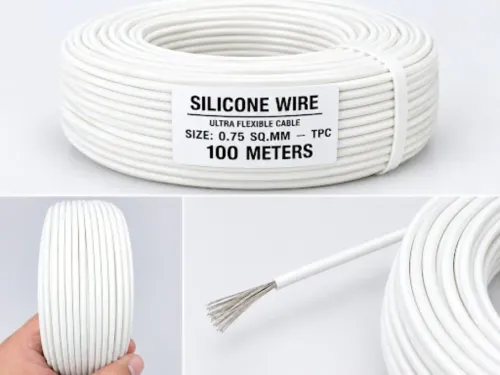
- Use a silicone RTD cable for flexible, hot routing where oil, solvents, abrasion, and crush are controlled. Silicone handles heat and bending well but is not automatically the right choice for a washdown, cutting, or oil-soaked area.
- Select mineral-insulated cable with MgO when the route demands compact construction and extreme heat. Exposed MgO absorbs moisture, reducing insulation resistance, so require moisture-resistant or hermetic terminations, controlled storage, and an insulation-resistance test after installation.
- Match the temperature rating to the hottest cable point, including the probe entry and terminal enclosure. A shielded RTD cable still fails if its jacket, seal, or transition cannot tolerate that temperature.
- For three-wire circuits, match lead resistance and temperature exposure between the two compensating wires. Choose four-wire construction when route length, gradients, or the error budget makes residual lead resistance unacceptable.
- Specify repeated-flex, vibration, tensile, crush, abrasion, and probe-entry tests, plus a defined bend radius. Ask for lot identification and change notification covering conductor, insulation, shield, termination, and calibration processes.
| Construction | Best fit | Check before approval |
|---|---|---|
| Silicone RTD cable | Flexible hot routing | Oil, abrasion, and bend limits |
| Mineral-insulated cable | Extreme heat or compact routes | MgO moisture control and termination |
| Shielded RTD cable | Electrically noisy routes | Shield type, coverage, drain wire, and leakage values |
Control noise, leakage, and installation errors
Long runs turn small leakage and resistance errors into temperature errors. Specify RTD cable shielding around the twisted measurement conductors, plus a drain wire that terminates with the shield according to the plant grounding design; connecting the shield at one end prevents a ground loop in many installations.
Route the cable away from motor leads, variable-frequency-drive outputs, relays, and high-current conductors. Cross unavoidable power cables at 90 degrees.
- Ask for measured conductor resistance, insulation resistance at a stated test voltage, and pair-to-pair and conductor-to-shield leakage.
- Require those values at the expected service temperature for high-temperature runs; room-temperature results can hide insulation deterioration.
- For mineral-insulated cable, protect exposed MgO from moisture with a hermetic or moisture-resistant termination, store cable ends sealed, and perform an insulation-resistance test after RTD cable installation.
- Match every field terminal to the sensor diagram. In a three-wire circuit, keep the two compensated leads equal in resistance and temperature exposure; use four-wire measurement when route length, gradients, or the error budget is demanding.
- Keep cable polarity and terminal labels consistent from sensor to transmitter, and inspect crimped or screw connections for loose strands and exposed insulation.
RTD signal interference is not solved by a shield alone. Select a cable with documented insulation, leakage, and resistance performance, then verify continuity, lead balance, shield isolation, and insulation resistance before energising the loop. A failed check is cheaper to correct at the junction box than after unstable process readings appear.
Require evidence, samples, and engineering support from the supplier
A dependable supplier will separate sensor calibration from cable or assembly testing and installed-loop verification. In an RTD cable manufacturer comparison, require IEC 60751 compatibility, the stated Pt100 tolerance class, conductor resistance, insulation resistance, leakage results, and a sample before approval.
Rewari Cable Industries can be asked to define these acceptance details for the proposed cable and RTD cable assemblies rather than relying on a catalogue temperature rating.
Request these records for the exact production lot:
- An RTD cable test report showing test voltage, test temperature, conductor resistance, insulation resistance, pair-to-pair leakage, and conductor-to-shield leakage.
- A calibration certificate stating the method, reference standard, uncertainty, adjustment status, and environmental conditions; do not treat it as proof of the installed loop.
- A construction drawing identifying conductor count and gauge, insulation, shield, drain wire, jacket, termination, bend radius, and maximum service temperature.
- A traceability record linking the batch number to materials, test results, termination work, and change notifications.
- A representative sample, including a terminated assembly, for bend, continuity, insulation, moisture, and fit checks.
| Evidence | Catalogue-only seller | Engineering supplier |
|---|---|---|
| IEC 60751 and tolerance | Nominal resistance only | Class A or Class B stated with temperature basis |
| High-temperature performance | Room-temperature figures | Test temperature and acceptance limits recorded |
| Support after selection | Datasheet and quotation | Wiring review, response-time conditions, installation advice, and failure analysis |
For mineral-insulated cable, ask for moisture-resistant termination and an insulation-resistance test after installation. If fast control response matters, demand assembled sensor response-time data; cable electrical rating alone cannot predict thermal lag.
Related product
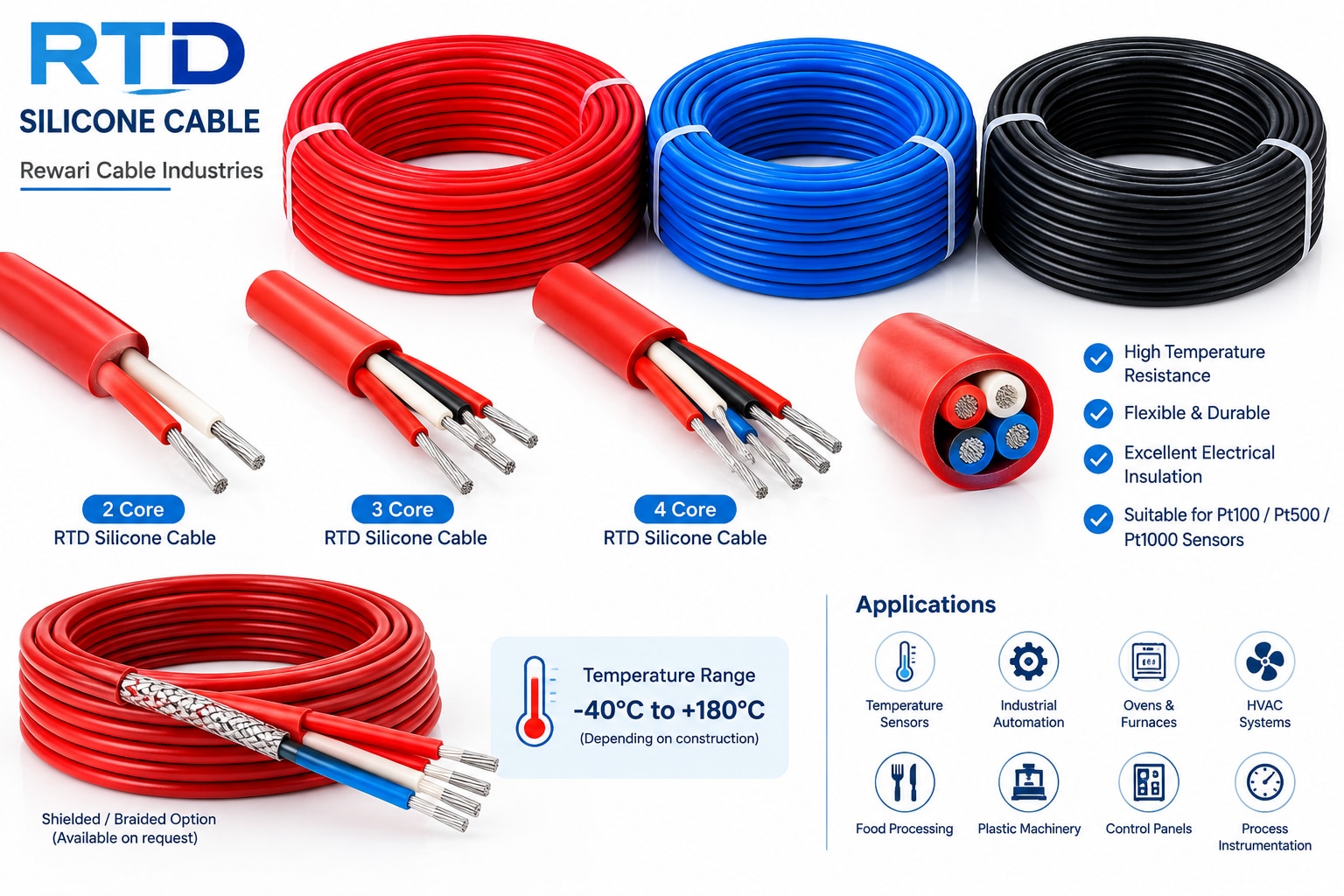 | RTD Silicone Cable Rewari Cable Industries offers RTD Silicone Cables designed for temperature measurement and signal transmission in industrial environments. View product → |
Compare total cost and long-term supply reliability
A low RTD cable cost does not guarantee a low installed cost. Before comparing quotes, specify IEC 60751 and the required tolerance class: for a Pt100, Class A is ±(0.15 + 0.002|t|) °C and Class B is ±(0.30 + 0.005|t|) °C.
Require conductor resistance per metre, total loop resistance, and the assumed run length; 1 Ω in a two-wire Pt100 circuit creates roughly 2.6 °C of error near 0 °C.
| Compare | Include in the calculation | Risk if omitted |
|---|---|---|
| Price | Cable, custom RTD cable length, terminations, testing, freight, tooling, minimum order, and installation waste | A cheap metre rate becomes an expensive installed run |
| Delivery | Quoted RTD cable lead time, production capacity, raw-material availability, and safety stock | A shutdown waits for cable |
| Continuity | Lot identification, change notification, retained samples, and a documented substitute | Construction changes alter resistance or leakage unnoticed |
Ask each industrial cable supplier for a firm lead time tied to the quoted specification, not a catalogue estimate. Request recent measured insulation resistance, conductor resistance, and leakage results at the intended service temperature; room-temperature figures alone do not prove performance.
- Require written notification before changes to conductor material, insulation, shield, termination, or calibration process.
- Compare a second-source sample against resistance, dimensions, bend radius, and electrical test results before approving substitution.
Frequently asked questions
What should you define before comparing RTD cable manufacturers?
Define the RTD type, conductor count, transmitter input, required accuracy, cable length, installation temperature, and IEC 60751 tolerance class.
Which cable construction details matter for an industrial RTD installation?
Compare conductor material and size, insulation, overall jacket, shielding, drain wire, flexibility, temperature rating, chemical resistance, and mechanical protection.
How can you reduce noise, leakage, and wiring errors in an RTD circuit?
Use the correct two-, three-, or four-wire configuration, separate RTD wiring from power cables, ground the shield correctly, control insulation resistance, and label every conductor.
What evidence should an RTD cable manufacturer provide?
Request construction drawings, datasheets, samples, resistance and insulation test results, temperature ratings, batch traceability, and calibration or compliance documents that match the supplied cable.
How should you compare the long-term cost of RTD cable suppliers?
Include purchase price, installation time, testing, replacement access, lead time, minimum order quantities, failure risk, technical support, and supply continuity.