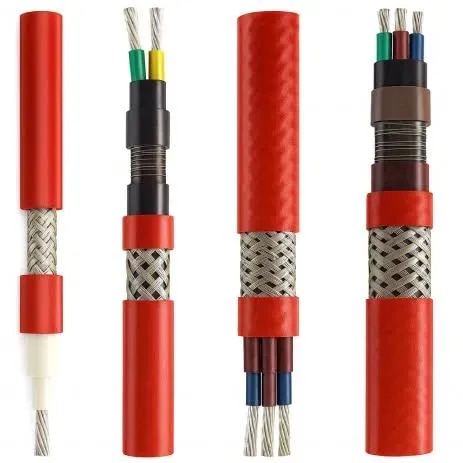
Rewari Cable Industries offers Heat Trace Cables for controlled electric heating, freeze protection, and process temperature maintenance of pipes, tanks, vessels, valves, and other industrial equipment. Heat-tracing systems are available in self-regulating, constant-wattage, longline, and mineral-insulated constructions depending on the application. Key Features Self-regulating and constant-wattage options Designed for freeze protection and temperature maintenance Flexible construction for pipe and equipment installation Consistent heat output according to cable type Suitable for industrial and commercial applications Available with protective braid and outer jacket options Can be supplied with suitable connection and termination accessories Custom wattage, voltage, length and temperature requirements Types of Heat Trace Cable 1. Self-Regulating Heat Trace Cable Automatically adjusts heat output according to surrounding temperature. It is commonly used for pipe freeze protection and low-to-medium temperature maintenance. 2. Constant Wattage Heat Trace Cable Provides a fixed heat output per metre and is suitable where consistent heat input is required for process temperature maintenance. 3. Longline Heat Trace Cable Designed for longer heating circuits and pipeline applications where conventional heating cables may not provide sufficient circuit length. 4. Mineral Insulated Heat Trace Cable Used for demanding high-temperature industrial applications where robust construction and high-temperature performance are required. Applications Pipe freeze protection Water and process pipelines Tanks and vessels Valves and instrument lines Chemical processing Petrochemical plants Oil & gas applications Food and pharmaceutical processing Water and wastewater treatment Refrigeration systems Roof and gutter de-icing Process temperature maintenance Industrial equipment heating Customization Rewari Cable Industries can supply Heat Trace Cables according to application requirements, including voltage, wattage per metre, cable length, temperature rating, insulation/jacket material, shielding/braid and termination arrangement. Important Selection Parameters The correct cable should be selected based on required maintenance temperature, pipe/tank dimensions, ambient conditions, circuit length, heat loss and hazardous-area requirements.